Activities
Learn, discuss and take actions. We keep on working to be in harmony with biodiversity.
With our sights on becoming businesses that are in harmony with biodiversity, JBIB member companies are regularly and continuously engaged in activities including the following.
1. Working Groups
The working groups are the most central of JBIB activities. Meetings are usually held on the same day as the monthly liaison meeting. Among the broad range of themes concerning companies and biodiversity, those that member companies share interest in are selected and working groups are formed. Both research and actual practices are done together. All regular members must join at least one working group.
Working group themes are reviewed each year to reflect the interests of member companies. And, once every few years, working groups are added or restructured as deemed necessary.
In 2020, working groups were run on five themes. Please see the Working Groups page for details. In 2021, two new working groups were added.
2. Lecture Course
This is JBIB’s introductory course for businesspeople who are engaging in biodiversity for the first time. Held every other month for a total of six times over a period of one year, it provides them with the knowledge and skills needed for their company to engage in biodiversity. This course is not only for new JBIB members, but is also attended by member company employees who have been newly charged with biodiversity.
Annual curriculum:
(1) What is biodiversity: Significance for companies
(2) Engaging in biodiversity as an organization
(3) Learning from pioneering companies
(4) Managing risks on biodiversity through procurement
(5) International trends for business and biodiversity
(6) Partnerships with NPOs and NGOs
3. Collaboration with external specialists
In order to learn about the latest achievements in this field and to deepen our understanding on biodiversity and ecosystems, JBIB invites university professors and other external specialists to hold seminars and also implement joint research from time to time.
Examples of lectures by external specialists:
- “The Climate Crisis and Water Risk,” HASHIMOTO Junji, President, aqua-sphere. Water Literacy Labo
- “Countermeasures for Invasive Alien Species,” GOKA Koichi Ph.D., National Institute for Environmental Studies, Japan
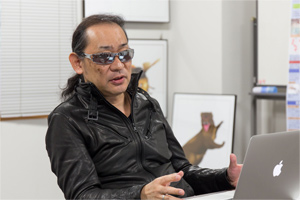
- “City Values and Green Infrastructure,” Prof. ICHINOSE Tomohiro, Keio University
4. Dialogues with NGOs and authorities
We convey our perception of issues and exchange information with NGOs and government agencies by hosting dialogue meetings. Our members and executive director (the head of the secretariat) are often asked to participate as members of relevant government committees.
Recently held dialogues:
- “The EU Biodiversity Strategy,” Delegation of the European Union to Japan
- “Business and Biodiversity Focusing on the Primary Industry,” Ministry of Agriculture, Forestry and Fisheries, Japan
- “COP15 and the Post-2020 Global Biodiversity Framework,” Ministry of the Environment, Japan
- Introduction to the Activities of NGOs including Asaza Fund, NACS-J, Conservation International Japan, and WWF Japan
5. Ecosystem experience
As JBIB focuses on biodiversity and ecosystems, it is essential for us to know about and actually experience this on-site in nature. We, therefore, hold a study tour once a year and make site visits to observe good practices in the field.
Recent study tours:
- Visit to Shiga and Kyoto to study green space design for factories and stores that is biodiversity friendly (2017)
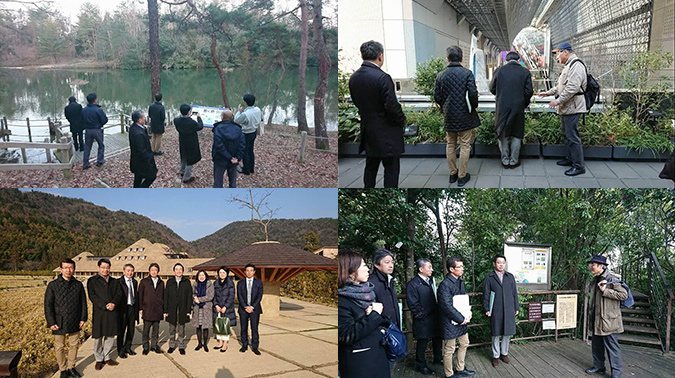
- Visit to Okayama to study mitigation of biodiversity impacts from mega solar power plants, community biomass power generation, and value-added wood product manufacturing (2018)

Site visits are also conducted twice a year to study initiatives taken in Tokyo and nearby areas. As the COVID-19 pandemic forced these visits to be cancelled in 2020, in their place, we asked companies that we had planned to visit to introduce their activities online.
6. Meetings for executives
The understanding and commitment of company executives are essential to mainstream biodiversity in business. We hold informal meetings for executives of JBIB member companies a few times a year so that they can discuss recent topics and learn from each other as well as from external experts. We believe this is a rare and unique opportunity for business executives to deepen their understanding.
7. Seminars and symposium
In order to extend our network and share our proceedings, JBIB organizes seminars at relevant exhibitions including the Eco-Products Exhibition, which is the largest environmental trade fair held annually in Japan.
Another popular event is the annual symposium, “Business Talking Biodiversity,” hosted by MS&AD Insurance Group Holdings, Inc. This symposium inspired the start of JBIB when it was first held in 2007. It has been held 14 times since then.
Examples of recent major seminars and symposiums:
- Held a symposium on marine plastics (EcoPro 2018)
- Held a symposium on green infrastructure and the SDGs (EcoPro 2019)
- Held an online seminar on initiatives for biodiversity in the food and retail sectors (2020)
8. Outgoing lectures
We are confident in our belief that JBIB members are Japan’s leaders in terms of business and biodiversity. Members are working proactively based on experiences gained through active membership in JBIB. As a result, JBIB and its member companies are often invited to speak at conferences, seminars and symposia both within Japan and abroad.
Examples of past speaking engagements:
- Invited to speak at ASEAN Centre for Biodiversity (ACB) South-East Asian Regional Workshop on Business and Biodiversity (Bangkok), 2009
- Invited to speak at CSR Asia Summit (Kuala Lumpur), 2011
- Co-organized a seminar with Birdlife International, Bombay Natural History Society and other organizations, and invited to speak at a side event, both at CBD COP11 (Hyderabad), 2012
- Invited to speak at ASEAN Conference on Biodiversity (Bangkok), 2016
- Invited to speak at Business & Nature Forum 2017 organized by WBCSD Singapore and Birdlife International (Singapore), 2017
We have also had numerous speaking opportunities in Japan.