Declaration of Support for Zero Deforestation
Forests provide various ecosystem services, and hence are considered to be one of the most important ecosystems on our planet.
However, as the impacts of human activities, notably those of companies spread, corporate activities have become both directly and indirectly involved, such as through their supply chains, in the destruction of forests that have been cleared for the expansion of agricultural land and other purposes to secure the raw materials essential for business, and those impacts have, moreover, been expanding.
As a result, rather than seeing an end to the momentum for deforestation, it is accelerating in some regions.
Reflecting growing awareness of how necessary it is to avoid the further destruction of natural forests, the Aichi Biodiversity Targets and the New York Declaration on Forests (NYDF) set clear goals for zero deforestation.
In 2015, the historic Paris Agreement and the Sustainable Development Goals (SDGs) were adopted, with both indicating the necessity for more thorough protection of forests to, respectively, keep global warming well below 2°C and make our society sustainable.
To that end as well, greater emphasis has come to be placed on the need to protect and increase forests which are important carbon-sinks.
Against this backdrop, more and more companies are striving to achieve those targets, and the number of companies calling for zero deforestation have been increasing as well. At JBIB, we have been incorporating biodiversity considerations in our daily business processes.
We recognize, however, that even greater efforts are needed to achieve those targets and goals within the time remaining. In order to further accelerate our activities and make even stronger contributions, we made the following declaration on June 20, 2018.
Declaration:
With the aim to make deeper contributions to the conservation of biodiversity through business activities and to spread sustainable business models, JBIB supports international actions for zero deforestation consistent with the New York Declaration on Forests (NYDF), which was adopted at the UN Climate Summit in September 2014 to cut forest loss in half by 2020 and strive to end it by 2030.
Accordingly, JBIB supports the following kinds of initiatives for zero deforestation taken by companies to:
- prevent destruction or degradation of natural forest ecosystems in the process of their own business operations;
- manage the sourcing of raw materials so that not only their own business operations, but that of their supply chains, do not destroy natural forest ecosystems;
- place priority on using low risk raw materials by utilizing internationally recognized certification systems and due diligence so that they do not contribute to the destruction of natural forest ecosystems;
- promote the conservation and generation of green areas on corporate grounds and carry out afforestation or reforestation by taking biodiversity into account, and contribute to the conservation and restoration of local biodiversity and ecosystems.
In order to support companies in advancing the above activities, JBIB will work together with other initiatives of the world, as well as with governments, external experts, NGOs and other organizations.
The information and materials needed to promote these efforts will also be provided to companies, and the specific content of initiatives and the progress made will be reported annually.
Results:
As stated in the declaration, along with advancing activities to propel zero deforestation, JBIB is checking the progress made and reporting on this annually. We introduce some of those results here.
In FY 2020, JBIB carried out the following kinds of activities.
- At the monthly liaison meetings, the latest activities of corporations, investors, NGOs and others are shared with the member companies to serve as reference for their respective promotion of activities.
- In the Working Group for Study of Sustainable Supply Chains as well, trends in zero deforestation are watched and ongoing discussions are conducted.
- In December 2020, JBIB held an online seminar titled “What initiatives for biodiversity are now expected from food and retail sectors?” This focused on the food and retail industries which are deeply related to deforestation through their sourcing of raw materials. Along with the current situation of deforestation, we introduced how companies are addressing this issue. And, as a result of calling upon companies in relevant sectors through such seminars, several food and beverage related companies newly joined JBIB from FY 2021.
- JBIB provided special cooperation to the “Business Talking Biodiversity Part 14,” a symposium hosted by MS&AD Insurance Group Holdings, Inc. in February 2021. There, we introduced international trends in the keynote lectures in the first part, and at themed sessions in the second part, provided more detailed explanation on the latest trends, including zero deforestation, from the two different aspects of procurement and finance, with discussions then conducted on how to advance such actions.
Progress made by JBIB member companies for zero deforestation
In April 2021, a questionnaire survey was conducted on the 45 JBIB member companies regarding the progress of their initiatives. We received responses from 35 of them (26 regular members and 9 associate members). Some of the key results are as follows.
Q1: Does your company understand the necessity of zero deforestation, and its trends? (multiple answers allowed)
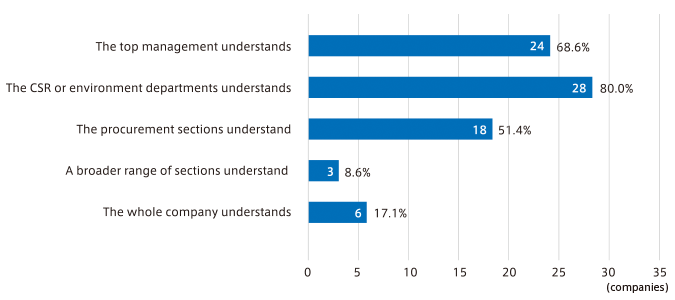
The necessity of zero deforestation and its trends were understood by not only the CSR or environment departments (80.0%), which lead actions in the company, but also the management (68.6%) and procurement sections (51.4%). Notably, understanding of the management rose significantly by 15.3 percentage points from the previous year.
Q2: Is your company committed to zero deforestation?
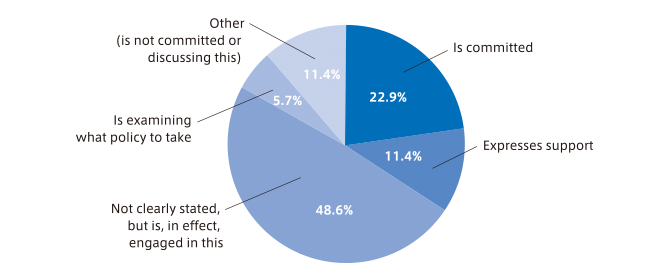
When those responding “is committed” and “expresses support” are combined, one-third of the JBIB member companies have let it be known that they support zero deforestation. When “is, in effect, engaged in this” is added, it is seen that over 80 percent of the companies are working positively for zero deforestation. This is a solid increase from the 66.6 percent of the previous year.
Q3: Does your company have a procurement policy that gives due consideration to biodiversity?
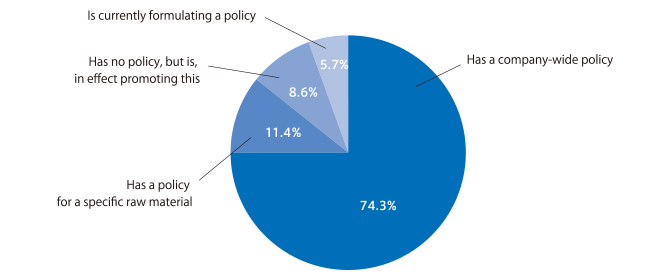
Of the JBIB member companies, 85.7 percent have a procurement policy that gives due consideration to biodiversity, and when including companies that have no policy but are, in effect, promoting such actions, 94.3 percent of JBIB members are actually considering biodiversity in their sourcing practices. Biodiversity conservation is thus becoming mainstream in procurement.
The companies are also conducting their own activities such as building structures using local wood from areas where they conduct business; branding such local wood; and not discarding but effectively using timber from forest thinning. For details of each individual company’s activities, please see Member Initiatives.