Working Group for
Study of Sustainable Town Planning
Cities are home to more than half of the world’s population and are one of the major consumers of ecosystem services, consuming over three quarters of the world’s natural resources. As issues such as inequality, poverty, and vulnerability to natural disasters are often concentrated in urban areas, countries and local governments around the world are struggling to find ways to respond to these challenges.
JBIB believes that the key to developing sustainable cities lies in the utilization of biodiversity and ecosystem services embodied by green spaces in urban areas, and we have been engaged in activities to enhance the quality of corporate greenery.
In order to confirm that companies are properly undertaking the management of such spaces, we started a certification system in 2013 that is based on a Land Use Score Card, and established the Association for Business Innovation in harmony with Nature and Community (ABINC) to implement this. In 2019, ABINC launched the ABINC ADVANCE certification for districts that give due consideration to biodiversity.
However, to realize town development that is truly in harmony with biodiversity, we believe that it is essential to not only consider biodiversity, but to also rethink urban development from the perspective of sustainability and successfully link this to biodiversity.
To that end, these activities have been broadened from site-specific activities to cover entire towns. The purpose of the Working Group for Study of Sustainable Town Planning is to conduct studies and tests on how such activities can be applied in sustainable town planning as per the Sustainable Development Goals (SDGs).
For example, increasing high quality corporate greenery that can be pleasantly used by anyone and everyone would also foster consideration toward those in vulnerable situations and establish public spaces. Green infrastructure could also be harnessed to build more resilience to natural disasters, which will be occurring more frequently due to the progression of climate change.
Developing plans through dialogue between local inhabitants and companies, and having the two parties together handle the daily management of the town could also enhance resilience by boosting local community strength and fostering a culture of connectedness wherein people help one another in times of emergency.
In addition, protecting and preserving the natural and cultural legacies that remain in urban areas to create towns with signature characters could foster biodiversity and cultural diversity, cultivate civic pride, and eventually enhance the town’s sustainability.
With such thoughts in mind, the Sustainable Town Planning Working Group is conducting the following activities:
– Undertaking studies on what conditions are necessary for sustainable town planning that conserves natural ecosystems.
– Developing a tool kit, such as a check list, to advance such sustainable town planning.
– Reflecting the knowledge gained from these studies in specific urban development projects.
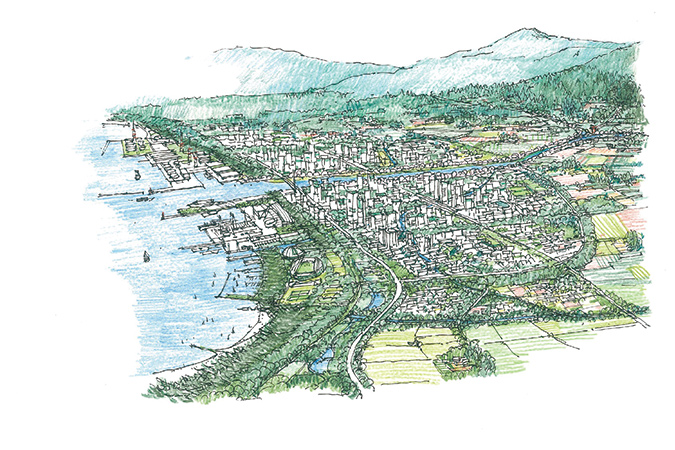
* A town in harmony with nature: Ecosystems are the foundation for the sustainability of cities. Town planning that makes the most of ecosystem functions leads to the creation of attractive towns. Networking greenery and developing green infrastructure provide multiple benefits such as enhanced disaster management and control, including flood mitigation, and improvement of the area’s living environment.
Participant Companies
AEON Co., Ltd.
GREEN WISE Co., Ltd.
Mitsubishi Estate Co., Ltd.
Mori Building Co., Ltd.
Osaka Gas Co., Ltd.
Regional Environmental Planning Inc.
Shimizu Corporation
Sekisui House, Ltd.
Takenaka Corporation